


Customized transformer finned heat sink: What key dimensions need to be checked when confirming drawings?
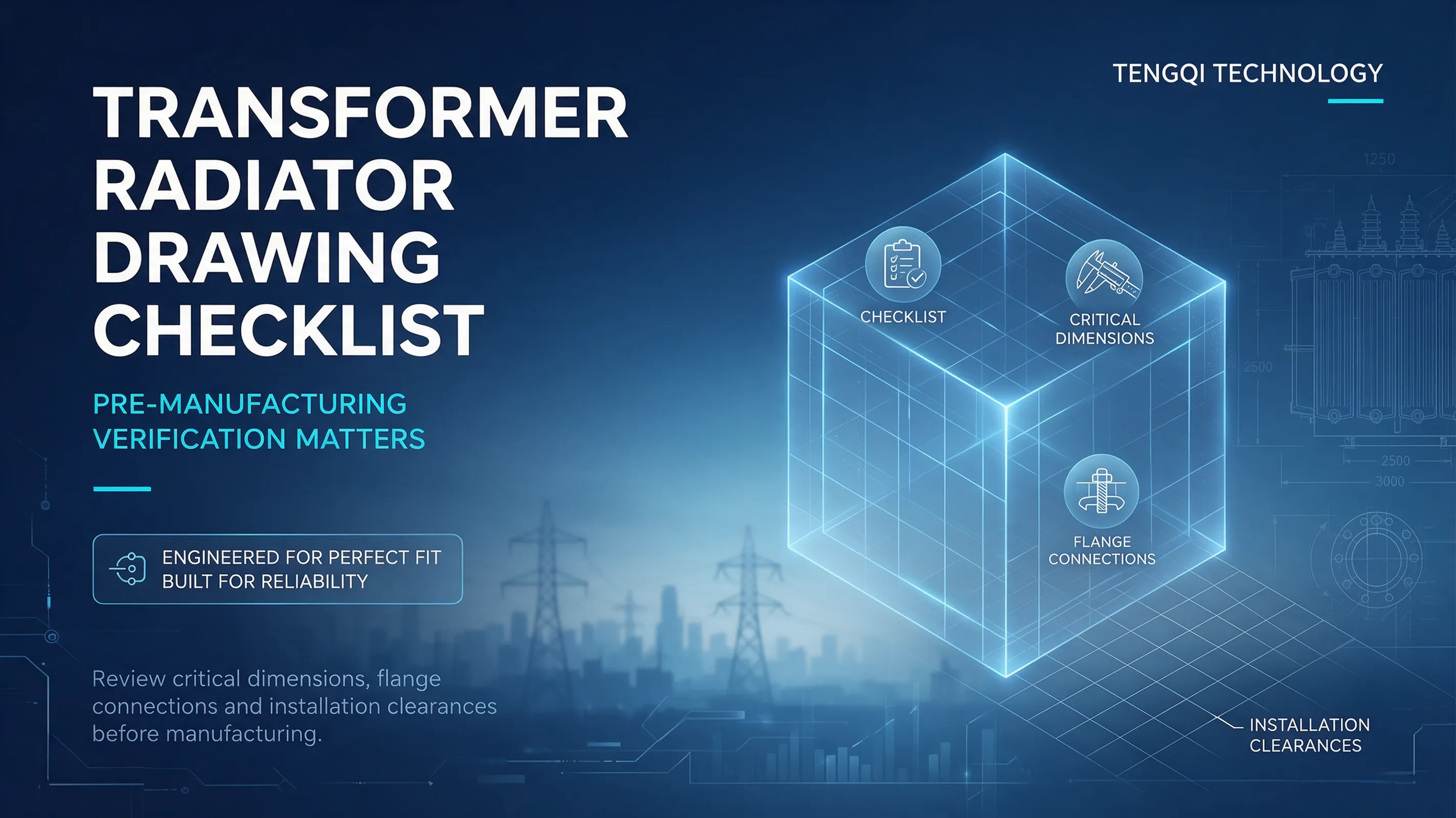
The value of a radiator drawing lies not only in illustrating how the product is manufactured, but also in demonstrating its compatibility with transformer interfaces, installation space, and project technical requirements. For custom projects, drawing review should shift from checking individual component dimensions to verifying the overall system compatibility.

First establish a common benchmark, then discuss whether complementary standards can be established.
It is recommended that the radiator assembly drawing, transformer interface drawing, and installation layout drawing be reviewed in the same round. First, confirm the drawing number, version, unit, and viewing direction, and then verify the dimensions. The purchasing, design, and manufacturing parties should use the same set of valid documents; after drawing modifications, the changes should be recorded and the replaced old version should be clearly identified.
For interface center distance, overall height, and clearance distance, in addition to the numerical values themselves, it is also necessary to measure whether the dimensions of the enclosure interface and the center distance are correct. Especially when there is offset or special structure, the direction and reference should be marked on the drawings. The position of the interface should not be determined by the model or photograph alone to ensure that it is not obstructed by enclosure components.
Check each layer from the connection point to the outer contour.
Key point: Same center distance does not mean the same overall size.
The center distance between the upper and lower interfaces is used to verify the connection position; the total height, width, and depth are related to whether the heat sink can fit into the reserved space. Both types of dimensions should be confirmed separately and taken into account the protruding range of the accessories and the manufacturing tolerances specified in the project.
- Structural configuration: Check whether the plate width, number of plates, plate spacing, and the position of the oil collection pipe and interface are consistent with the confirmation diagram.
- Spatial Boundaries: Inspect the outer contours of the radiator body, interfaces, and accessories to identify confined areas near the surrounding structure.
- Special offset: Confirm the front view direction, distance and measurement reference to avoid judging the three-dimensional position only from the front view.
- Dimensional tolerances: Check allowable deviations in conjunction with drawings and project technical documents; locations with limited space should be clearly marked and carefully reviewed.
Interface review should be implemented down to the assembly relationship.
The nominal dimensions of the flange are only one part of the connection verification. The flange shape, the arrangement of the connection holes, the sealing surface and the installation direction should also be checked against the drawings of both parties, and the upper and lower interfaces, left and right directions and viewing angles should be clearly defined.
When a project requires valves, seals, or fasteners, their compatibility with interfaces and the scope of supply from each party should be verified. When replacing existing radiators, valid drawings or verified on-site measurement data should be used; if discrepancies are found between the drawings and the actual product, the differences should be clarified before determining the manufacturing basis.
Provide an installation path, not just an installation location.
The radiator's shape is within the reserved area, but it still needs to be confirmed whether it can be hoisted, connected, and maintained. In conjunction with the overall transformer layout, the following relationships should be checked carefully:
- Are the hoisting and moving paths restricted by pipelines, supports, sleeves or other accessories?
- Is there sufficient space around the connecting bolts for tool operation?
- Are the valves, venting and oil draining points easily accessible and operable?
- When configuring fans for a project, consider whether their layout and support structure are coordinated with the radiators.
The required space should be determined by the specific project design and installation conditions, and the dimensions of other equipment cannot be directly applied.
What needs to be reviewed simultaneously when structural changes are made?
When adjustments are made to the number of panels, panel spacing, interfaces, or overall structure, the heat dissipation design and installation conditions should be reviewed simultaneously, rather than simply updating the outline drawings. Material, plate thickness, welding, surface protection, inspection, and labeling requirements should also be clearly specified in the drawings or related technical documents.
For fixed, detachable, or other special structures, the connection method, supply status, and scope of accessories must also be confirmed. Specific technical requirements and inspection arrangements shall be based on the project documents confirmed by both parties.
Create an executable verification record before manufacturing.
It is recommended to compile a list of unresolved issues, responsible parties, and confirmation results, and link them to the final drawing number, version, and technical documents. If any changes are subsequently made, the impact on manufacturing, installation, inspection, and delivery arrangements should be reassessed, and relevant records updated before implementation.
Customization communication with Tengqi Technology
TengQi Technology (TQT) can conduct technical communication on the selection and customization of transformer plate heat sinks based on customer equipment parameters, application scenarios and project requirements.
When consulting, it is recommended to provide radiator requirement drawings, transformer interface diagrams, installation layout or space specifications, and relevant technical requirements. For replacement items, please supplement with site photos and verified dimensional records to jointly confirm the matching boundaries.


Hot Products


Popular articles



Need Radiator Selection or Custom Engineering Support?
Share your transformer parameters, cooling requirements or project conditions. TQT's engineering team will support product selection and customized solutions.